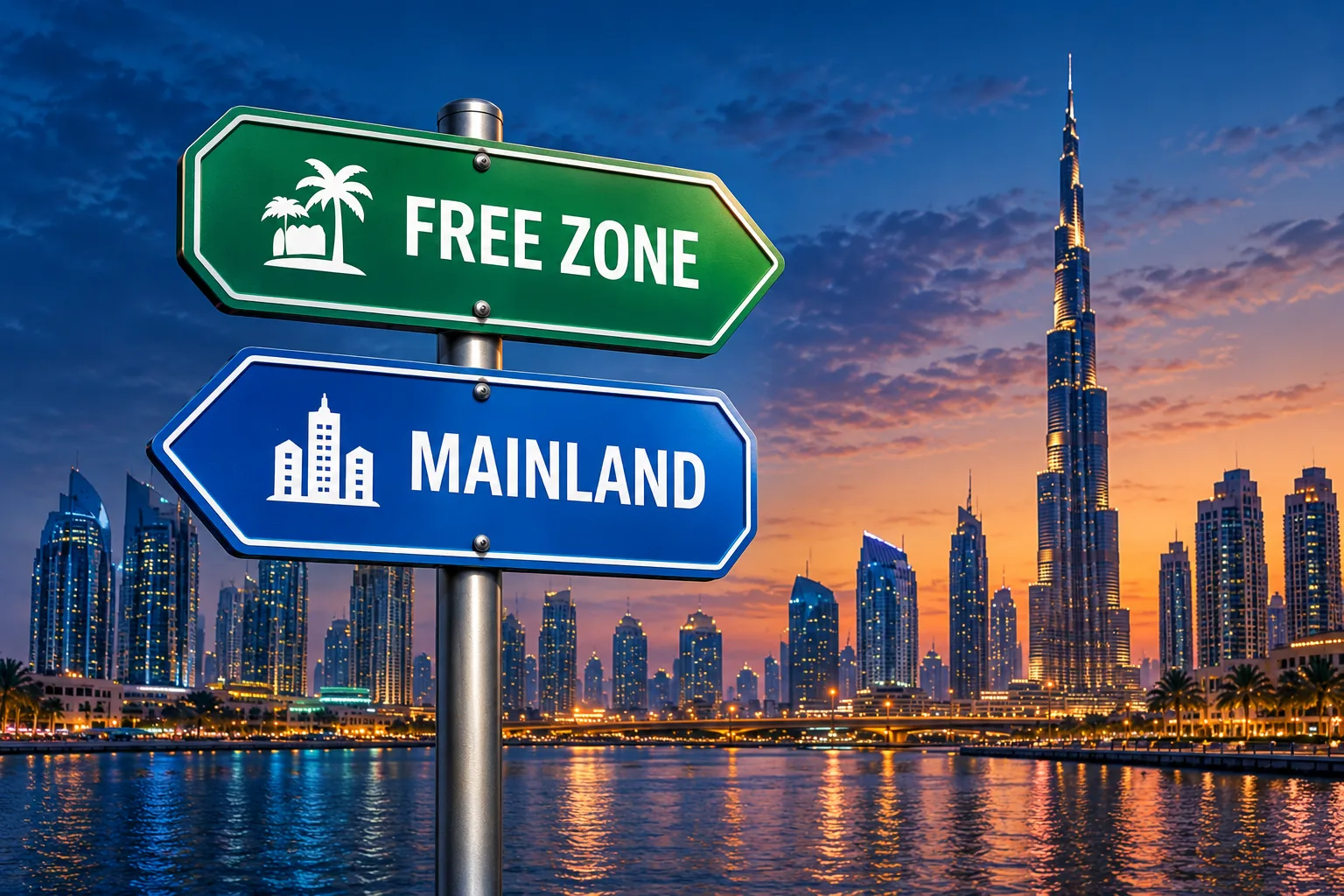
If you want the flexibility to work with clients anywhere in the UAE, the mainland is usually the right call. We'll help you understand what that means for your business and handle everything from start to finish.
What we handle
Reviewing your business activity and advising on the right structure
Reserving your trade name and getting initial approvals
Registering your company and processing your trade license with DET
Drafting your MoA and preparing legal documents
Coordinating your office lease and Ejari, if needed
Free zones are popular for good reason. Full ownership, a cleaner process, and they work well for a lot of business types. We'll help you find the right one and take care of everything from there.
What we handle
Helping you choose the free zone that fits your business
Preparing your application and coordinating with the authority
Getting your company incorporated and your license issued
Guiding you through shareholder documentation
Supporting with visas and banking if needed
Offshore structures sound complicated, but they really don't have to be. We'll walk you through what it actually involves and help you set things up properly without the confusion.
What we handle
Advising on the right offshore structure for your situation
Planning jurisdiction and ownership
Preparing registration documents and supporting incorporation
Helping with banking and compliance once you're set up
Not knowing which license you need is one of the most common things we hear. We'll work that out with you and handle everything, whether it's a new license, an amendment, or a renewal.
What we handle
Explaining which license type suits your activity
Registering your trade name and getting approvals
Processing new licenses, amendments, and renewals
Getting third-party approvals and following up with authorities
Your visa is something you really want done right. We make sure the process is clear and handled properly so you're not left guessing at any stage.
What we handle
Checking eligibility and walking you through the process
Preparing and submitting your documents
Processing your establishment card, residency, and immigration steps
Government processes can be genuinely confusing. We deal with this every day, so we know exactly what's needed, who to speak to, and how to keep things moving.
What we handle
Liaising with government departments and submitting documents
Processing with GDRFA and MOHRE
Handling work permits, employee visas, labour contracts, and renewals
We help you find the right activity and make sure it lines up with UAE regulations.
Mainland, free zone, offshore — we help you think it through properly so you're not just guessing.
We prepare and submit everything correctly the first time, so you don't end up going back and forth.
We manage the licensing process from beginning to end.
Your investor visa, residency, and company-linked immigration needs are handled as part of the process.
Once you're up and running, we're still here for compliance, legal documentation, and whatever comes up down the line.



We listen first, understand what you're building, then figure out the right structure together.
Name reservation, initial approvals, and early documentation all kick off here.
Every legal requirement and authority approval gets handled properly.
We help with lease agreements and Ejari, where needed.
Investor visas, employee visas, labour requirements — all sorted so you're ready to operate.


There's no one-size-fits-all answer here. Costs shift depending on your licence type, what your business actually does, and whether you're going mainland or free zone. You're generally looking somewhere between AED 12,000 and AED 50,000 — sometimes more. What we do at Nexture is sit down with your specific situation and build out a clear cost breakdown. No guesswork, no surprise invoices at the end.
Yes — and this is one of the biggest misconceptions people still carry. The UAE overhauled its company laws in 2021. For most mainland business activities, full foreign ownership is now the default. No local sponsor required. Free zones have always been that way. So if ownership was the thing keeping you from making the move, it's genuinely no longer the obstacle it once was.
For most of the process, no. Licence applications, document submissions, approvals — a lot of it can be handled remotely, and some free zones are built specifically with this in mind. Where it gets a bit more complicated is around bank account opening and residence visas — those typically do require you to be present at some point. But we handle everything we can on your behalf, so when you do make the trip, it's quick and purposeful.

Setting up a remote company in Dubai used to sound complicated. Today? It’s surprisingly doable.
With digital portals, e-signatures, and remote-friendly business zones, you can handle most of the process from your laptop, whether you’re in India, Europe, or anywhere else.
But “possible” doesn’t mean “effortless.” You still need the right documents, decisions, and approvals lined up. Let’s walk through exactly what you’ll need.
Yes, in many cases, you can.
Dubai has made serious moves toward a digital business setup. You can apply online, upload documents, reserve your company name, and even receive your license without being physically present.
That said, it depends on your setup. Some jurisdictions are more remote-friendly than others.
Also, if you plan to get a visa, you may still need to travel later for medical tests and biometrics. So while incorporation can be remote, a few final steps might not be.
Before anything else, you’ll need to choose where your business will sit.
Mainland companies are ideal if you want to operate directly in the UAE market. You get broader access, but the process can be slightly more involved.
Free zones are where remote founders usually start. They offer simpler procedures, faster approvals, and make the remote company setup in Dubai much smoother.
If your focus is on global clients or digital services, free zones are often the easier path. If you’re targeting local customers, Mainland might make more sense.
Here’s where things get real. Before you even apply, you need clarity on a few basics:
Your business activity (what exactly you’ll do)
The legal structure (LLC, sole proprietorship, etc.)
A few trade name options (in case your first choice isn’t available)
Shareholder details (who owns the company)
Basic incorporation information
This stage matters more than people think. A vague business activity or wrong structure can slow everything down later.
For most online company setup in Dubai processes, you’ll need:
A clear passport copy
A recent passport-size photo
Shareholder details
UBO (Ultimate Beneficial Owner) information
Visa or Emirates ID (if you already have one)
Any extra approvals if your activity requires it
Everything is usually submitted digitally. Just make sure your documents are clear and match across the board; small errors can cause delays.
If your company will be owned by another company (instead of an individual), expect a bit more paperwork.
You may need:
A board resolution approving the new company
Existing company incorporation documents
Memorandum and Articles of Association
A copy of the current trade licence
ID documents of managers and shareholders
It sounds like a lot, but it’s standard. Authorities just want to verify who’s behind the business.
Even with a smooth virtual business setup in Dubai, approvals are part of the process.
Typically, you’ll go through:
Trade name reservation
Initial approval from authorities
Additional approvals for regulated activities (like finance or healthcare)
In some cases, immigration-related approvals
Most of these steps happen online now, which speeds things up significantly.
The answer is often no, but sometimes yes.
You can usually complete the incorporation process remotely. That’s the big win. But if you’re applying for a visa, opening certain bank accounts, or finalizing identity verification, you might need to visit briefly.
So if your goal is to start a remote business in Dubai and manage it from abroad, you’re in luck. If you want to relocate, plan for a short trip.
This depends on your licence.
Many free zones offer flexi-desks or virtual office options, which are perfect for remote founders. You get a legal business address without renting a full office.
Mainland companies, however, often require a physical office space. That adds cost and a bit more paperwork.
So again, your setup choice matters, not just for ownership, but for how you operate daily.
Yes, in many cases, you can complete the setup remotely. Some later steps, like visa processing, may require a visit.
Typically a passport copy, photo, shareholder details, and basic company information. Additional documents depend on your setup.
No, a visa isn’t required just to start a company. It’s only needed if you plan to live or work in the UAE.
For most remote founders, yes. It’s simpler, faster, and more flexible.
Common issues include unclear documents, wrong business activity selection, or missing approvals.
Setting up a remote company in Dubai is no longer a complicated, paperwork-heavy process. It’s structured, digital, and surprisingly accessible. Choose the right jurisdiction, prepare your documents properly, and understand what’s required from day one.
Do that, and you’ll find that building a business in Dubai, from anywhere in the world, is not just possible, but practical.

If you’ve been wondering whether you can run a business without living in Dubai, the short answer is yes, you absolutely can. It’s one of the most common questions entrepreneurs ask today, especially with remote work becoming the norm.
Let’s break down how you can operate a UAE business as a non-resident..
Yes, in many cases, non-residents can set up and run a business in the UAE. You don’t always need to live there to get started.
That said, ownership can depend on the type of business activity you choose. Some sectors are wide open, while a few still come with restrictions.
The structure you pick, mainland, free zone, or offshore, also plays a big role. It shapes everything from ownership rules to how you operate day-to-day.
This is where most people pause. Should you go for the mainland or the free zone?
Mainland companies give you access to the UAE market. You can trade freely within the country and even work with government contracts. It’s a solid option if you want a strong local presence.
Free zones, on the other hand, are often the go-to for non-residents. They offer full foreign ownership, simpler setup, and, in many cases, the ability to open a company in Dubai remotely.
So, what’s the catch? Free zone companies usually have limited direct access to the mainland market unless you work through a distributor.
At the end of the day, your choice depends on your business model, local vs global focus, and physical vs remote operations.
Ownership and residency aren’t the same thing.
You can own a UAE company without relocating. That’s a big reason why so many founders are exploring a non-resident business setup in Dubai.
However, if you want to live in the UAE, hire employees, or actively manage things on the ground, you’ll likely need a visa. That’s where the broader UAE immigration guide and visa process come into play.
So think of it this way, you can start remotely, and move later if it makes sense.
You’ve got several options, and each comes with its own advantages:
Mainland company – Best for local market access
Free zone company – Ideal for remote founders and global operations
Branch or representative office – For expanding an existing business
Offshore company – Typically used for international trade or asset holding
If your goal is to start a business in Dubai without living there, free zones are often the simplest and fastest route.
In many cases, yes.
Recent reforms have made it possible for foreigners to fully own their businesses, especially in free zones and across most mainland activities.
That said, it still depends on what you’re doing. A handful of sectors remain restricted and may require local involvement.
But for most modern businesses, consulting, e-commerce, tech, services, 100% ownership is now the norm.
The process is more straightforward than you might expect. Here’s how it usually looks:
Choose your business activity
Select the right legal structure
Decide your jurisdiction (mainland, free zone, offshore)
Reserve your trade name
Apply for initial approvals
Obtain your business licence
The good news? A lot of this can be done online. That’s why so many entrepreneurs can now easily explore how to open a company in Dubai remotely without ever setting foot in the country.
Not always.
You don’t need a visa just to own a business. That’s a key advantage of the UAE system.
But if you plan to relocate, work within the company, or sponsor employees, then yes, you’ll need to go through the UAE immigration process and apply for a residence visa.
So again, it comes down to your goals. Remote ownership? No visa required. Full relocation? That’s a different story.
While the process is flexible, it’s not completely friction-free. Here are a few common pitfalls:
Choosing the wrong jurisdiction for your business
Assuming every activity allows 100% ownership
Delays in approvals due to incomplete documents
Banking challenges (this one trips up many founders)
Missing compliance or renewal deadlines
None of these is a deal-breaker. But they’re worth knowing upfront so you don’t hit unnecessary roadblocks.
Yes, foreigners can start and own a UAE company without being residents, especially in free zones.
In most cases, yes. Many business activities allow full foreign ownership.
For remote setup and simplicity, free zones are often a better fit. Mainland works better for local market access.
No, not for ownership. But you’ll need one if you plan to live or work in the UAE.
Yes, many businesses can be fully managed online using digital tools and local support services.
So, can you run a business without living in Dubai? Absolutely.
The UAE has made it easier than ever for global entrepreneurs to set up, operate, and grow businesses remotely. Whether you’re testing a new idea or expanding internationally, the flexibility is hard to ignore.
The key is choosing the right setup from the start. Get that right, and the rest becomes a lot smoother.

Setting up a business in Dubai is a bit like choosing the right neighborhood for a new home. You want a place that fits your lifestyle, has the right amenities, and, most importantly, doesn’t break the bank while you’re trying to grow.
If you are trying to figure out the Dubai mainland vs freezone benefits for your business setup, here’s everything you need to know.
Think of a Mainland company as having an "all-access pass" to the city. These companies are licensed by the Dubai Department of Economy and Tourism (DET). Because they are "onshore," they aren't restricted by geographical boundaries within the UAE.
If you want to open a trendy cafe in Jumeirah, a construction firm that builds skyscrapers, or a retail shop in the Dubai Mall, the Mainland is your go-to. It’s designed for those who want to be right in the local economy.
Free zones are essentially specialized business hubs. Dubai has over 40 of them, each often catering to specific industries, like Dubai Media City for creatives or DMCC for commodities.
When you set up here, you’re operating within a "zone" that has its own rules and regulations. It’s incredibly popular for startups and international consultants because it’s streamlined. You get a sense of community with other businesses in your niche, and the setup is usually pretty fast.
The difference between mainland and freezone in Dubai usually comes down to four things: where you can trade, who owns the company, where you work, and how many people you can hire.
Feature
Dubai Mainland
Dubai Free Zone
Market Access
Unrestricted. Trade anywhere in the UAE and with the government.
Restricted. Trade within the zone or internationally only.
Ownership
100% Foreign. Now allowed for most commercial activities.
100% Foreign. Always the standard for all sectors.
Office & Visa
Physical Office. Requires a lease; visas scale with size.
Flexi-Desk. Co-working options; visas tied to license package.
Setup Model
DET Authority. Involves multiple government departments.
Zone Authority. Streamlined "one-stop-shop" process.
It used to be that Mainland companies required a local partner who owned 51% of the business. That’s largely a thing of the past now. Today, for most commercial and professional activities, you can have 100% foreign ownership on the Mainland.
Free zones have always offered 100% ownership by default. So, while the gap has closed, Free Zones still feel a bit more "expat-friendly" for those who want a simple, 100% solo structure from day one.
If your clients are local UAE residents or government entities, you need a Mainland license. If you try to do this with a Free Zone license, you’ll need a distributor or a local agent to "bridge" the gap.
However, if you’re a software developer in Dubai but your clients are all in London or New York, a free zone is perfect.
Mainland licenses are quite broad. You can often bundle several related activities under one license without much fuss. Free zones, however, can be a bit more protective of their "ecosystem."
If you’re in a Free Zone dedicated to tech, you’ve got to make sure your business activity aligns perfectly with the zone’s focus.
On the Mainland, having a physical office used to be a strict requirement, usually at least 200 square feet. While things are becoming more flexible, you generally need a "real" space with an Ejari (a registered lease).
For free zones, if you’re a one-person show, you can get a license that includes a few hours of desk space a week. It’s a massive cost-saver when you’re just starting out and don't need a fancy headquarters yet.
Hiring people? On the mainland, your visa quota is usually tied to the size of your office. The bigger the office, the more staff you can hire.
In a Free Zone, you might get two visas with a flexi-desk, and if you need five, you’ll likely need to upgrade to a physical office within that zone.
The mainland process involves the DET and sometimes other government departments like the municipality. It feels more "official" and involves a few more steps.
Free zones act as a one-stop shop. They handle your license, your visa, and your office space all under one roof. It’s usually faster, but you’re restricted to that specific zone’s authority.
While a Free Zone might look more affordable upfront, those yearly renewal fees and visa costs can add up.
Mainland setup often has higher initial costs because of the office lease and government fees, but it can be more cost-effective as you scale up and hire more people.
The UAE introduced a 9% corporate tax recently, and it applies to everyone. However, Free Zone companies can still enjoy a 0% rate on "qualifying income."
You should go Mainland if you’re planning to open a physical shop, a restaurant, or a service business that needs to travel to people’s homes across the city. It’s also the right move if you want the freedom to take on big government contracts.
If you’re a freelancer, a digital nomad, or a tech startup with an international focus, the Free Zone is your best friend. It’s also great for companies that want to be surrounded by peers in the same industry.
Choosing the Lowest Price: Don’t pick the cheapest package if it doesn't offer the market access you actually need.
Ignoring Activity Limits: Ensure your specific business activity is allowed in your chosen jurisdiction to avoid fines.
Miscalculating Visas: Free Zone visa quotas are often capped; make sure your license package supports your hiring plans.
Banking Blind Spots: Some banks have stricter requirements for certain free zones, which can delay your account opening.
Overlooking Tax Substance: You can’t just have a "shell" company; you need a real presence to qualify for tax benefits.
Neglecting Office Rules: Remember that Mainland requires a physical lease (Ejari), while some Free Zones don't.
Neither is better since it's all about your business model. Mainland is better for local trade; the free zone is better for international services and ease of setup.
Not directly. You usually need to work through a distributor or get a specific branch permit, which can be extra paperwork.
For the vast majority of business activities, the answer is no. You can now own 100% of your mainland company.
Usually, yes, for the initial setup, especially if you use a flexi-desk. But for larger teams, Mainland can sometimes be more economical.
If you want a quick setup, Free Zones are very investor-friendly. If you want to integrate into the local economy, the Mainland is the way to go.
The choice of mainland vs freezone company setup in Dubai is the foundation of your business. Take a breath, look at where your customers are, and choose the path that lets you grow without limits. Both options are good - you just need the one that fits your specific requirements.